General Aptitude
Part A assesses general aptitude, including logical reasoning, numerical ability, quantitative comparison, graphical analysis and data interpretation.
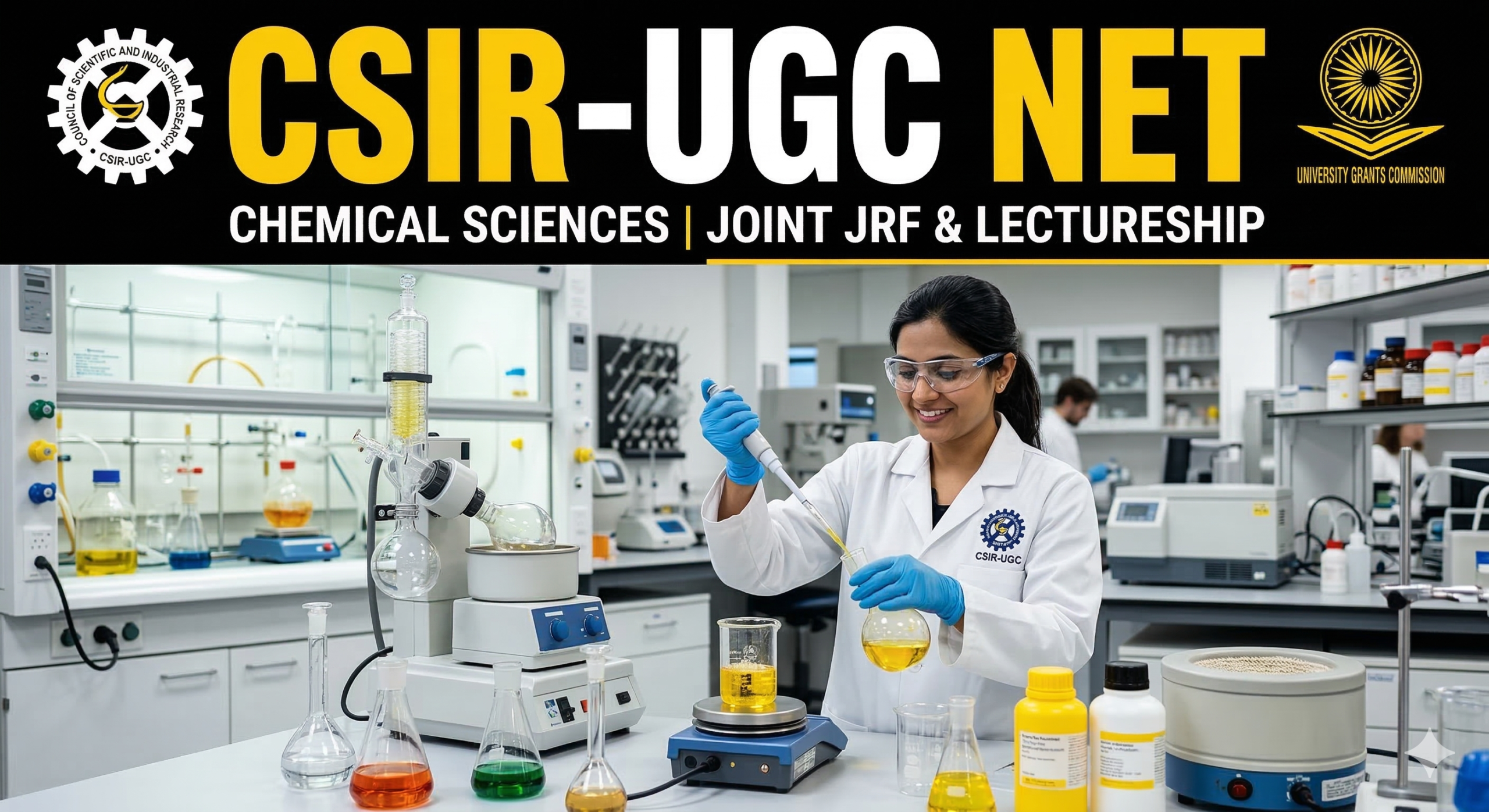
Explore the syllabus, exam pattern, preparation strategy, recommended books, previous year questions, courses, test series and study material for CSIR-UGC NET Chemical Sciences.
Understand the purpose, structure, subjects, career opportunities and preparation requirements of the CSIR NET Chemical Sciences examination.
The CSIR NET (Council of Scientific and Industrial Research – National Eligibility Test) is one of India’s most prestigious national-level examinations for students pursuing careers in scientific research and higher education. Conducted by the National Testing Agency (NTA) on behalf of the Council of Scientific and Industrial Research (CSIR), the examination determines the eligibility of candidates for Junior Research Fellowship (JRF), Assistant Professor and PhD admission in various science disciplines.
For Chemistry graduates and postgraduates, the CSIR NET Chemical Sciences examination is considered one of the most important milestones for building a successful career in research, teaching and innovation. Every year, thousands of students appear for the examination to secure admission into prestigious institutions such as IITs, IISc, NITs, Central Universities, CSIR laboratories, IISERs and other leading research organisations across India.
Unlike many competitive examinations that primarily test factual knowledge, the CSIR NET Chemical Sciences Exam evaluates a candidate’s conceptual understanding, analytical thinking, scientific reasoning and problem-solving ability. The examination is designed to assess whether candidates possess the academic foundation required for advanced research and higher education in Chemistry.
The examination consists of three sections—Part A, Part B and Part C.
Part A assesses general aptitude, including logical reasoning, numerical ability, quantitative comparison, graphical analysis and data interpretation.
Part B evaluates subject-specific knowledge and the candidate’s understanding of fundamental concepts in Chemical Sciences.
Part C focuses on advanced analytical and application-based questions that require deeper conceptual understanding and scientific reasoning.
The syllabus covers the major branches and core concepts of Chemistry.
Candidates are expected to develop a strong command of fundamental concepts, reaction mechanisms, spectroscopy, chemical bonding, quantum chemistry, coordination chemistry, electrochemistry, thermodynamics, kinetics, organometallic chemistry and modern analytical techniques.
Qualifying the examination can open multiple academic, teaching and research career pathways.
Successful candidates can pursue funded PhD programmes through the Junior Research Fellowship, subject to applicable admission and fellowship requirements.
Qualified candidates can become eligible for Assistant Professor positions in colleges and universities, subject to the recruitment criteria of the institution.
Candidates can pursue research opportunities in universities, CSIR laboratories, IITs, IISc, IISERs and other scientific institutions.
Chemistry graduates can explore opportunities in research and development, scientific organisations, government institutions and PSUs, depending on individual recruitment requirements.
Effective preparation requires conceptual understanding, structured practice and consistent revision.
Develop strong conceptual clarity in every subject.
Follow a structured and realistic preparation strategy.
Revise important concepts, formulas and reactions regularly.
Solve topic-wise and year-wise previous year questions.
Attempt mock tests and analyse incorrect answers.
Practise advanced analytical and application-based questions.
Preparing for the CSIR NET examination requires more than simply covering the syllabus. Candidates should focus on conceptual clarity, regular revision, solving previous year question papers, attempting mock tests and practising analytical questions. A structured preparation strategy, combined with quality study material and consistent practice, can significantly improve examination performance.
At Chiral Academy, we are committed to helping students achieve their academic goals through comprehensive CSIR NET Chemical Sciences coaching, expert faculty guidance, topic-wise study material, previous year question paper discussions, mock tests, test series, revision classes and performance analysis.
Our learning resources are designed to help aspirants strengthen their concepts, improve problem-solving skills and confidently prepare for every stage of the examination.
Whether you are beginning your preparation or aiming to improve your performance, understanding the complete structure of the CSIR NET Chemical Sciences Exam is the first step towards achieving success.
Explore the sections below to learn about the CSIR NET syllabus, exam pattern, preparation strategy, reference books, previous year question papers, mock tests, study material, test series and courses specially designed for Chemistry aspirants.
Explore CSIR NET Syllabus ↓Explore the complete CSIR NET Chemical Sciences syllabus, including Inorganic Chemistry, Physical Chemistry, Organic Chemistry and Interdisciplinary Topics.
Download and save the complete subject-wise syllabus for preparation, revision and study planning.
Use the syllabus as a preparation checklist and track your topic-wise progress throughout your CSIR NET preparation.
Understand the complete CSIR NET Chemical Sciences exam pattern, including the number of questions, questions to attempt, marks distribution and negative marking in Part A, Part B and Part C.
The CSIR NET Chemical Sciences examination is divided into three parts: Part A, Part B and Part C. Each part evaluates a different set of skills and follows a specific question-attempt limit, marks distribution and negative-marking scheme.
Tests logical reasoning, graphical analysis, analytical and numerical ability, quantitative comparison, series formation, puzzles and data interpretation.
Contains conventional multiple-choice questions based on fundamental and subject-specific concepts from the CSIR NET Chemical Sciences syllabus.
Tests scientific concepts, their applications, analytical thinking and problem-solving ability. These questions require a deeper understanding of Chemistry.
| Section | Total Questions | Questions to Attempt | Marks per Correct Answer | Negative Marking | Maximum Marks |
|---|---|---|---|---|---|
| Part A | 20 | 15 | 2 Marks | 0.5 Mark | 30 |
| Part B | 40 | 35 | 2 Marks | 0.5 Mark | 70 |
| Part C | 60 | 25 | 4 Marks | 1 Mark | 100 |
| Total | 120 | 75 | — | — | 200 |
The examination is conducted in a computer-based test format.
The total duration of the examination is 180 minutes or three hours.
Candidates are not required to attempt every question available in each part.
Attempting more than the prescribed limit does not increase the maximum marks available for that part.
Part C carries the highest weightage and requires advanced conceptual and analytical ability.
Careful question selection is important because incorrect answers attract negative marking.
Candidates should first attempt questions they can solve accurately and confidently. In Part C, avoid unnecessary guessing because every incorrect answer results in a deduction of one mark. A balanced strategy can help maximise the final score while minimising negative marks.
Explore recommended reference books for Physical Chemistry, Organic Chemistry and Inorganic Chemistry to strengthen your concepts and prepare effectively for the CSIR NET Chemical Sciences examination.
Download the complete subject-wise reference book list and save it for your preparation.
No single book is required to be studied from beginning to end. Aspirants should select books according to the topic, use them to strengthen concepts and combine reference-book study with syllabus analysis, previous year questions and regular revision.
Begin with the official syllabus, select one primary book for each topic and use additional books only when a concept requires deeper explanation. After completing a topic, solve CSIR NET previous year questions to understand how the concepts are tested in the examination.
Understand why solving previous year questions is one of the smartest and most effective strategies for qualifying the CSIR NET Chemical Sciences examination.
Access chapter-wise Chemical Sciences previous year questions for concept practice, revision and self-assessment.
Preparing for the CSIR NET Chemical Sciences examination requires much more than reading theory and memorising concepts. Every year, thousands of aspirants study from similar books, attend lectures and solve practice questions, but only a limited number qualify for Junior Research Fellowship and Assistant Professor eligibility.
One major factor that separates successful candidates is the consistent practice of CSIR NET Previous Year Questions . PYQs help students understand how Chemistry concepts are tested, recognise frequently repeated topics and develop the analytical thinking required for Part B and Part C.
This section provides free chapter-wise resources to help aspirants understand the examination pattern, strengthen conceptual clarity, improve speed and build confidence before the examination.
Previous year papers are the closest representation of the actual examination. They reveal how concepts are tested, which chapters carry greater importance and what level of scientific reasoning is expected from candidates.
Become familiar with Part A, Part B and Part C questions, question distribution, difficulty level, time management and negative marking.
Discover chapters and concepts that appear frequently and prioritise them during preparation and revision.
Identify weak concepts, common errors, alternative approaches and faster methods while solving examination-level questions.
Learn how examiners combine multiple concepts in numerical, mechanism-based, statement-based and analytical questions.
Regular timed practice improves question selection, calculation speed, accuracy and examination stamina.
Questions may change, but important ideas such as aromaticity, spectroscopy, bonding and reaction intermediates are tested repeatedly.
Solving several years of actual questions reduces uncertainty and makes the real examination feel more familiar.
Practise elimination techniques, logical reasoning, approximation methods and time-saving calculations.
Use PYQs to identify strong subjects, weak chapters, recurring mistakes and areas requiring further revision.
Repeated PYQ practice helps candidates score more consistently, avoid unnecessary mistakes and manage the paper effectively.
Solve every question before checking the answer.
Use a timer to simulate examination conditions.
Study every solution and understand the concept used.
Maintain a separate notebook for errors and weak topics.
Revise incorrect and doubtful questions every week.
Reattempt each chapter after completing revision.
Classify mistakes as conceptual, calculation or guessing errors.
Combine PYQ practice with regular mock tests.
Success in CSIR NET Chemical Sciences is not determined by how many books you read. It depends on how effectively you apply your knowledge under examination conditions.
Previous year papers bridge the gap between theory and actual performance. Make PYQ solving a regular habit, analyse every mistake and revise the important concepts repeatedly.
Download Free CSIR NET PYQs →Prepare for CSIR NET Chemical Sciences with expert faculty, complete syllabus coverage, live and recorded classes, practice questions, test series, mentorship and continuous academic support.
At Chiral Academy, we believe that success in competitive Chemistry examinations comes from expert teaching, strong conceptual understanding, consistent practice and continuous mentorship.
Our courses provide a complete preparation ecosystem for students preparing for CSIR NET Chemical Sciences, IIT JAM Chemistry, GATE Chemistry, MH SET, Assistant Professor, Geo-Chemist and other competitive Chemistry examinations.
Whether you enrol in a Standard Course or a PRO Course, you receive structured learning support designed to strengthen concepts, improve problem-solving ability and maximise your examination performance.
Explore currently available live and recorded batches, compare course benefits and choose the right preparation programme for your examination.
Learn from experienced and passionate educators who simplify difficult concepts and develop the analytical skills required for competitive examinations.
Every important topic is taught in a structured, exam-oriented manner according to the current syllabus and examination pattern.
Attend concept-oriented live classes with real-time faculty interaction, doubt solving and regular revision sessions.
Learn at your own pace, pause difficult concepts, revise repeatedly and access lectures according to batch validity.
Practise chapter-wise assignments after lectures with detailed video discussions and regular concept reinforcement.
Study complete CSIR NET and GATE PYQ discussions with detailed solutions, pattern analysis and smart problem-solving techniques.
Attempt unit tests, subject tests and full-length mock examinations with detailed analysis and rank-improvement strategies.
Receive continuous academic assistance through regular doubt-solving sessions throughout your preparation.
Get guidance for study planning, revision, time management, motivation and examination strategy.
A structured course containing the essential teaching, practice and assessment resources required for complete preparation.
Includes all Standard Course benefits along with premium recorded courses, advanced practice resources and additional test series.
| Course Feature | Standard Course | PRO Course |
|---|---|---|
| Experienced Faculty | ✓ | ✓ |
| Complete Syllabus Coverage | ✓ | ✓ |
| Live Classes* | ✓ | ✓ |
| Recorded Lectures | ✓ | ✓ |
| DPP with Video Solutions | ✓ | ✓ |
| Previous Year Questions | ✓ | ✓ |
| All India Test Series | ✓ | ✓ |
| Free Mentorship | ✓ | ✓ |
| Doubt-Solving Sessions | ✓ | ✓ |
| BRC Batch Access | × | ✓ |
| Questions Practice Batch | × | ✓ |
| 15,000+ Question Bank | × | ✓ |
| Reference Books Test Series | × | ✓ |
*Live features apply to live batches. Recorded batches include structured recorded lectures and associated course resources.
Experienced and dedicated Chemistry faculty
Structured and examination-oriented curriculum
Live and recorded learning options
Complete Organic, Inorganic and Physical Chemistry
Regular DPPs and question-practice sessions
Previous year question discussions
All India Test Series with detailed solutions
Free mentorship and academic guidance
Dedicated doubt-solving support
Affordable fees with maximum learning value
Chiral Academy helps students build strong Chemistry concepts, improve question-solving ability and prepare systematically for CSIR NET, IIT JAM, GATE Chemistry, MH SET and other competitive Chemistry examinations.
Test your preparation with structured unit tests, minor tests, full-length mock examinations, reference-book-based questions, detailed solutions and dedicated doubt support.
At Chiral Academy, we believe that consistent testing is one of the most important factors for success in competitive Chemistry examinations.
Our CSIR NET Chemical Sciences Test Series is designed to help aspirants evaluate their preparation, identify weak areas, improve speed and accuracy, reduce negative marking and develop the confidence required for the actual examination.
Students can choose between the All India Test Series and the advanced Reference Books Test Series according to their preparation requirements.
Explore available CSIR NET test series, compare features and enrol in the assessment programme that matches your preparation level.
Designed according to the latest CSIR NET Chemical Sciences examination pattern for systematic practice, regular assessment and performance improvement.
Designed for aspirants who want to practise advanced questions inspired by internationally recognised Chemistry reference books.
Practise individual chapters and topics systematically while building conceptual strength step by step.
Assess multiple chapters together and improve concept retention, speed and question-selection ability.
Experience the real CSIR NET examination pattern and build confidence under timed conditions.
Understand every important concept, identify mistakes and learn efficient problem-solving approaches.
The Reference Books Test Series also provides text solutions for convenient revision and self-study.
Each advanced question identifies its source reference book for further exploration and additional practice.
Analyse test performance, identify weak topics and improve preparation through regular assessment.
Receive academic assistance for difficult questions, confusing concepts and recurring errors.
Access high-quality examination-level testing and detailed solutions at an affordable launch price.
| Feature | All India Test Series | Reference Books Test Series |
|---|---|---|
| 33 Unit Tests | ✓ | ✓ |
| 6 Minor Tests | ✓ | ✓ |
| 8 Full-Length Mock Tests | ✓ | ✓ |
| Latest CSIR NET Pattern | ✓ | ✓ |
| Detailed Video Solutions | ✓ | ✓ |
| Written Text Solutions | × | ✓ |
| Reference-Book Source Mentioned | × | ✓ |
| Advanced Reference-Book Questions | ✓ | ✓ |
| Performance Evaluation | ✓ | ✓ |
| Doubt-Solving Support | ✓ | ✓ |
| Launch Price | ₹799 | ₹999 |
Latest CSIR NET examination pattern
High-quality examination-level questions
Standard reference-book-based practice
33 unit tests, 6 minor tests and 8 mock tests
Detailed video-solution discussions
Written solutions in the Reference Books series
Reference source mentioned for advanced questions
Performance evaluation and improvement strategy
Dedicated doubt-solving support
Affordable pricing and examination validity
The Chiral Academy Test Series is a complete performance improvement system designed to help aspirants identify strengths, overcome weaknesses and build the confidence required to excel in CSIR NET Chemical Sciences.
Your CSIR NET test series information will be added here.
Access free topic-wise study material, previous year questions, revision resources and downloadable Chemistry content covering the complete CSIR NET Chemical Sciences syllabus.
Quality study material plays an important role in building strong concepts and preparing systematically for the CSIR NET Chemical Sciences examination.
Chiral Academy provides free Chemistry resources for students who want to strengthen their understanding, revise important topics and practise examination-oriented questions without additional cost.
Study material is available for the major areas of the CSIR NET Chemical Sciences syllabus, including Organic Chemistry, Inorganic Chemistry and Physical Chemistry.
Explore topic-wise Chemistry notes, previous year questions, revision resources and free downloadable material for the complete syllabus.
The free resources are organised to support preparation across the major branches of Chemistry and important topics included in the CSIR NET Chemical Sciences syllabus.
Revise important definitions, concepts, formulas, mechanisms and examination-oriented theory in an organised format.
Practise topic-wise and chapter-wise questions to understand how Chemistry concepts are tested in the examination.
Use concise notes, reaction summaries and formula-based resources for quick revision before tests and the final examination.
Strengthen individual chapters through focused practice and topic-specific downloadable resources.
Focus on high-weightage concepts, commonly tested topics and analytical questions relevant to Part B and Part C.
Download available resources and use them for daily study, weekly revision and structured examination preparation.
Begin with the official syllabus and identify the topics you need to complete.
Study one topic at a time using lectures, notes and reference books.
Use the free material for revision after completing the main theory.
Solve topic-wise previous year questions immediately after revision.
Mark difficult concepts and revise them again every week.
Combine study material with mock tests and regular performance analysis.
Explore Chiral Academy’s free downloads and use the available resources to strengthen concepts, revise the complete syllabus and practise important examination questions.
Follow a structured preparation strategy covering concepts, previous year questions, regular revision, mock tests and performance analysis.
Preparing for CSIR NET Chemical Sciences requires much more than completing lectures or reading several reference books. Success depends on conceptual clarity, question practice, consistent revision and the ability to apply Chemistry concepts under examination conditions.
A well-planned preparation strategy helps students complete the syllabus systematically, identify weak topics, improve accuracy and develop confidence for Part A, Part B and analytical Part C questions.
Watch this detailed video to understand how to plan your syllabus, practise questions, revise effectively and prepare strategically for the examination.
Begin by reviewing the complete syllabus, the distribution of Part A, Part B and Part C, the question-attempt limits and negative marking.
Build a strong foundation in Organic, Inorganic and Physical Chemistry before moving towards advanced questions and reference-book problems.
Divide the syllabus into manageable chapters and assign realistic deadlines for lectures, notes, question practice and revision.
Maintain short notes for formulas, mechanisms, important reactions, exceptions, spectroscopy rules and commonly confused concepts.
Practise chapter-wise and year-wise PYQs to understand recurring concepts, question patterns and the level of analytical thinking required.
Use unit tests, subject tests and full-length mock tests to evaluate preparation, improve speed and reduce negative marking.
Classify errors as conceptual, calculation-based, careless or guesswork-related and revise the relevant topic immediately.
Schedule weekly, monthly and final revision cycles so that important formulas, reactions and concepts remain fresh until the examination.
Complete topic-wise PYQs immediately after each chapter.
Reattempt incorrect questions after one week.
Attempt unit tests before moving to the next subject.
Use minor tests to practise multiple chapters together.
Attempt full mock tests under three-hour conditions.
Analyse accuracy, time usage and question selection.
Revise class notes within 24 hours of studying.
Use one day every week only for revision.
Maintain separate formula and reaction sheets.
Revise mistakes from tests and PYQs regularly.
Use active recall instead of repeatedly reading notes.
Reattempt difficult questions during every revision cycle.
Concept learning and lecture revision.
Topic-wise question practice.
Previous year question solving.
Short revision of older chapters.
Review of mistakes and weak concepts.
Part A aptitude practice on selected days.
Studying from too many books without completing one source.
Watching lectures without solving questions afterwards.
Ignoring previous year questions until the final month.
Attempting mock tests without detailed analysis.
Neglecting weaker subjects and only revising favourites.
Guessing excessively in a negative-marking examination.
A successful CSIR NET strategy combines quality learning, regular PYQ practice, structured testing, repeated revision and honest performance analysis.
Find clear answers about the CSIR NET Chemical Sciences syllabus, eligibility, exam pattern, preparation strategy, books, mock tests, previous year papers, JRF, Assistant Professor eligibility and PhD opportunities.
CSIR NET Chemical Sciences is a national-level examination conducted by the National Testing Agency (NTA) to determine the eligibility of candidates for Junior Research Fellowship (JRF), Assistant Professor, and PhD admission in Chemical Sciences.
Candidates who have completed or are pursuing a Master’s degree in Chemistry or a related discipline from a recognized university with the required minimum marks are eligible to apply for CSIR NET Chemical Sciences.
The CSIR NET Chemical Sciences syllabus includes Physical Chemistry, Organic Chemistry, Inorganic Chemistry, Analytical Chemistry, and General Aptitude.
Yes. CSIR NET Chemical Sciences is commonly referred to as CSIR NET Chemistry, and both terms represent the same examination and syllabus.
The examination consists of three sections: Part A covers General Aptitude, Part B contains subject-based Chemistry questions, and Part C includes higher-order analytical Chemistry questions.
Yes. Negative marking is applicable for incorrect answers according to the official marking scheme.
The major subjects include Organic Chemistry, Physical Chemistry, Inorganic Chemistry, Analytical Chemistry, Spectroscopy, Quantum Chemistry, Chemical Bonding, Coordination Chemistry, and Reaction Mechanism.
Popular reference books include Atkins Physical Chemistry, Clayden Organic Chemistry, J.D. Lee, Huheey, Morrison & Boyd, Cotton, Banwell, and Skoog.
Beginners should first understand the complete syllabus, study standard reference books, solve previous year question papers, and practise mock tests regularly.
Yes. Previous year question papers help students understand the exam pattern, important topics, and frequently asked concepts.
Previous year question papers are available on the official website and educational platforms that provide CSIR NET study resources.
Yes. Mock tests improve time management, accuracy, and confidence, and help identify weak topics before the examination.
The paper consists of three parts with a fixed number of questions, out of which candidates need to attempt only the prescribed number according to the exam pattern.
Part A contains General Aptitude questions based on logical reasoning, numerical ability, analytical skills, graphs, and quantitative aptitude.
Part B contains subject-based multiple-choice questions covering the complete Chemical Sciences syllabus.
Part C consists of analytical and application-based questions designed to test conceptual understanding and problem-solving skills.
CSIR NET Chemical Sciences is considered a competitive examination. Success depends on conceptual clarity, regular practice, and consistent revision.
The preparation time depends on the student’s academic background, but consistent study with proper planning and revision significantly improves performance.
Yes. Candidates appearing in the final year of their Master’s degree can apply provisionally, subject to fulfilling the eligibility criteria.
JRF provides financial support for research during a PhD, while Assistant Professor eligibility allows candidates to apply for teaching positions in universities and colleges.
Qualified candidates can pursue PhD programmes, research fellowships, Assistant Professor positions, scientific research careers, and opportunities in PSUs and R&D organizations.
Yes. CSIR NET qualification is accepted by many universities and research institutions for admission to PhD programmes.
Many Public Sector Undertakings (PSUs) consider CSIR NET-qualified candidates for scientific and research-related positions, depending on their recruitment criteria.
Important topics include Chemical Bonding, Coordination Chemistry, Quantum Chemistry, Thermodynamics, Chemical Kinetics, Organic Reaction Mechanism, Spectroscopy, Pericyclic Reactions, Electrochemistry, and Organometallic Chemistry.
Coaching is not mandatory. Many candidates qualify through self-study using standard books, quality notes, previous year papers, and mock tests.
Focus on conceptual understanding, solve previous year questions, revise regularly, practise mock tests, and improve time management.
Part C generally carries the highest weightage because it contains analytical questions with higher marks.
Students can use online lectures, mock tests, practice quizzes, reference books, PYQs, and topic-wise study materials from trusted educational platforms.
Yes. CSIR NET qualification is one of the most respected credentials for careers in higher education, scientific research, and doctoral studies.
CSIR NET Chemical Sciences opens opportunities for research fellowships, PhD admission, teaching careers, government research organizations, PSUs, and advanced scientific research, making it one of the best career pathways for Chemistry graduates.
Explore the syllabus, exam pattern, preparation strategy, recommended books, previous year questions, courses, test series and study material for CSIR-UGC NET Chemical Sciences.
Introduction to CSIR NET (Chemical Sciences)
The Joint CSIR-UGC NET (National Eligibility Test) is a prestigious national-level examination conducted by the National Testing Agency (NTA) on behalf of CSIR (Council of Scientific and Industrial Research) and UGC (University Grants Commission). It determines the eligibility of Indian nationals for Junior Research Fellowship (JRF), Assistant Professor in Indian Universities & Colleges, and Admission to Ph.D. programs. For Chemical Sciences students, this exam is the gateway to a career in academia, research, and higher studies in chemistry. CSIR NET Chemical Sciences, CSIR NET Chemistry exam, JRF in Chemical Sciences, CSIR NET PhD admission, Assistant Professor eligibility Chemistry
benefits of CSIR NET Chemical Sciences, CSIR NET fellowship chemistry, CSIR NET salary, scope after CSIR NET Chemistry
CSIR NET eligibility for Chemical Sciences, CSIR NET age limit, MSc Chemistry eligibility for CSIR NET
CSIR NET eligibility for Chemical Sciences, CSIR NET age limit, MSc Chemistry eligibility for CSIR NET
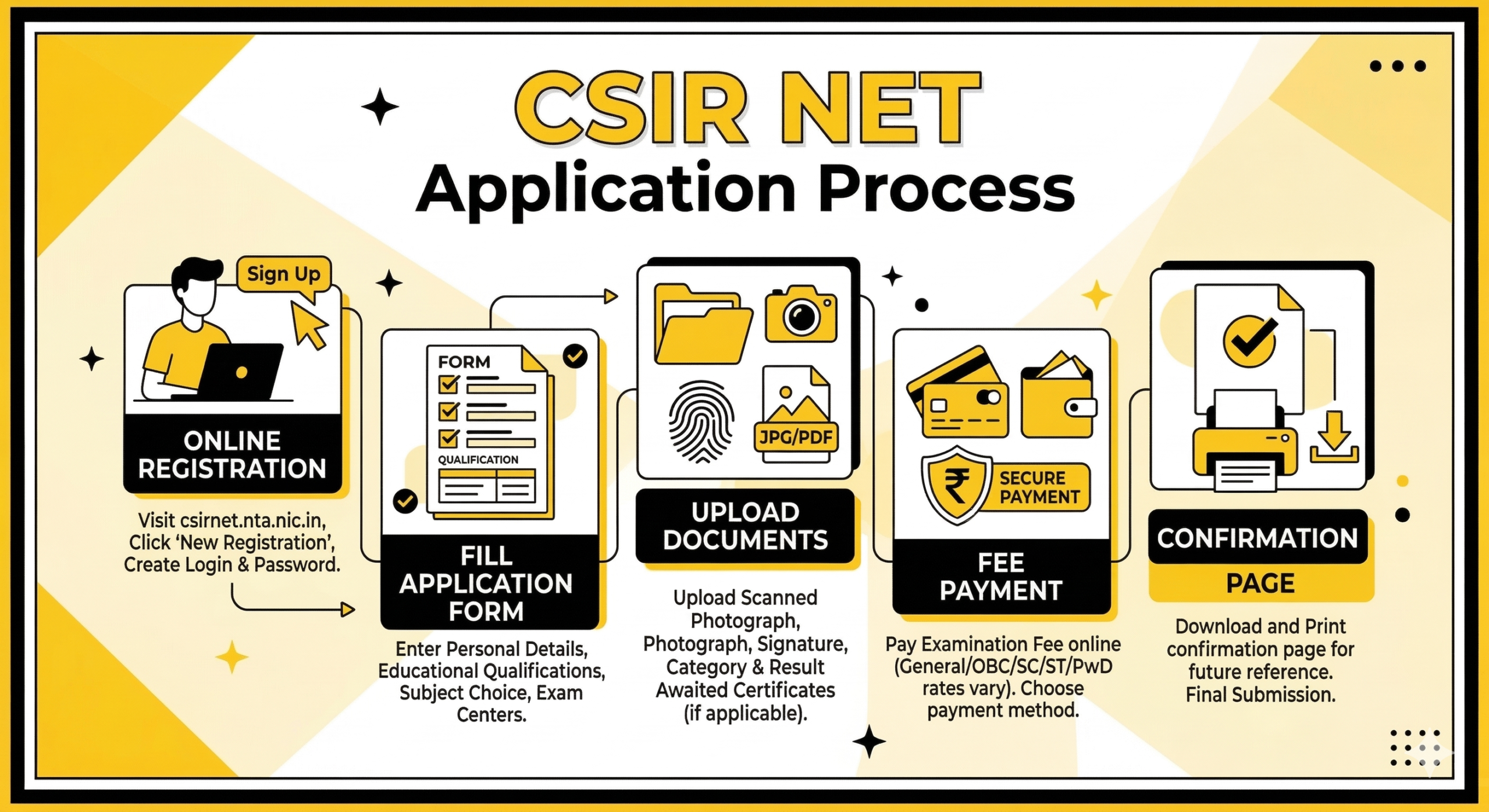
Enroll today and start your preparation for CSIR NET • GATE • IIT JAM • SET • PGT • NTPC with India's trusted Chemistry coaching platform.

Please login or register to access course materials and continue your learning.