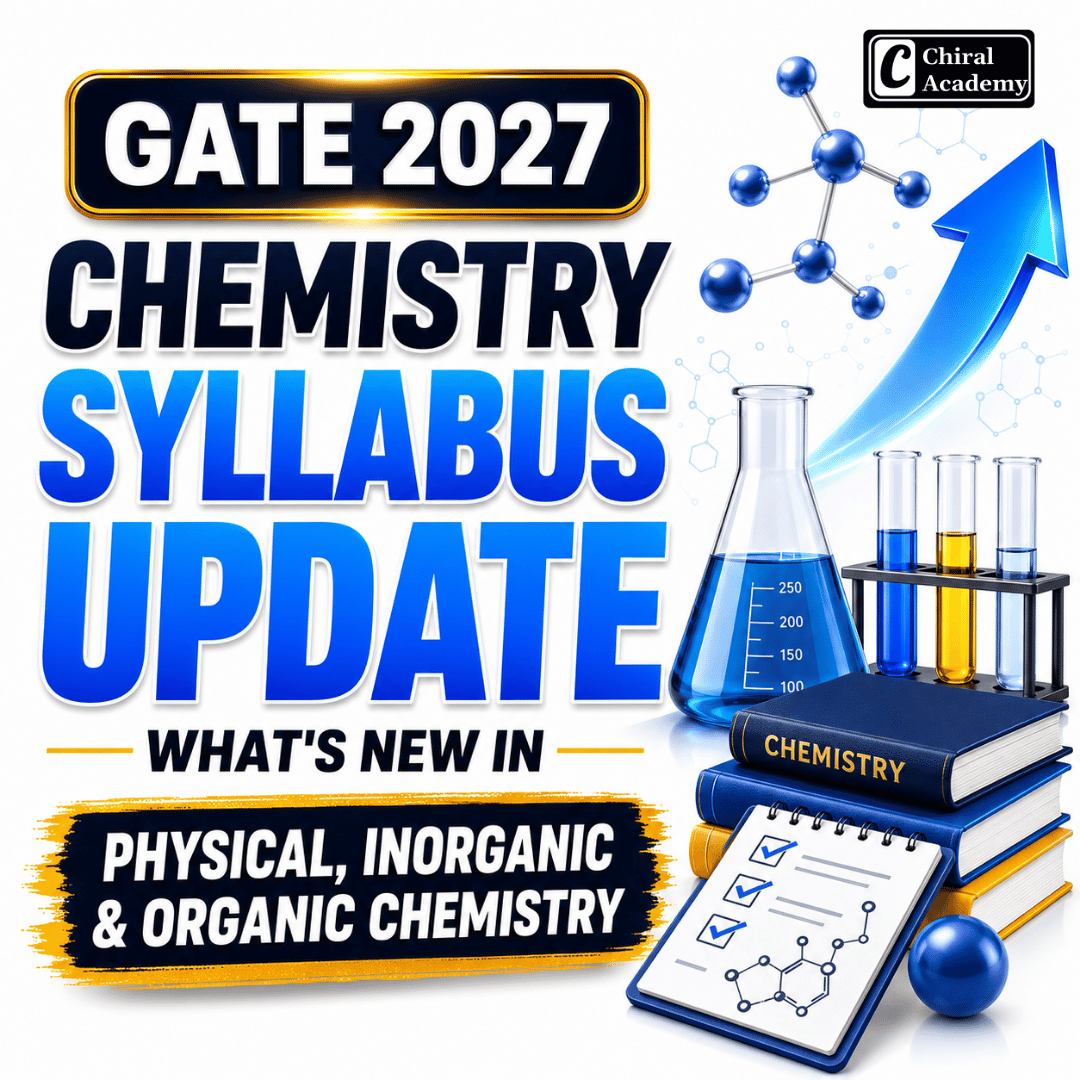
GATE 2027 Chemistry Syllabus Update: What’s New in Physical, Inorganic, and Organic Chemistry
- Posted by chiralacademy.com
- Categories Gate Chemistry CY
- Date July 21, 2026
- Comments 0 comment
Decoding the GATE 2027 Chemistry Syllabus
What’s New, What’s Gone, and How to Prepare
The revised GATE CY syllabus is more specific, more structured and significantly more detailed—especially in Quantum Chemistry, Group Theory, Inorganic Chemistry and Organic Synthesis.
A topic not explicitly named in the revised syllabus should not automatically be ignored if it supports another listed concept. Use the official syllabus as your final preparation checklist, but maintain the prerequisite knowledge needed to understand the retained topics.
The New Theme: Greater Specificity
Welcome, GATE Chemistry aspirants! The revised GATE 2027 Chemistry syllabus introduces several important changes that should directly influence your preparation plan.
The dominant theme of the revised syllabus is specificity. Several broad areas that previously appeared as general headings have now been divided into clearly named concepts, reactions, reagents, mathematical treatments and analytical methods.
This means that aspirants should no longer prepare only from broad chapter names. Your notes and practice plan should now cover each explicitly listed reaction, reagent, theory and application.
Topics Removed
Radioactivity, pseudohalogens, polarography and PMO treatment are no longer explicitly listed.
Topics Expanded
Quantum Mechanics, Group Theory, Spectroscopy, Organometallics and Photochemistry are more detailed.
New Explicit Sections
General Concepts, Oxidation and Reduction now appear as clearly defined Organic Chemistry areas.
Preparation Priority
Update your notes first, identify newly named topics and practise them through topic-wise questions.
What Is No Longer Explicitly Listed?
These topics were present in the previous Chemistry syllabus but do not appear as named topics in the GATE 2027 CY syllabus.
Radioactivity
The separate Radioactivity heading covering detection, decay processes, half-life, fission and fusion is no longer listed in the revised Inorganic Chemistry syllabus.
Pseudohalogens
Pseudohalogens have been removed from the named topics under Main Group Elements. Noble gases and interhalogen compounds remain in the syllabus.
Polarography
Polarography is no longer listed among the electroanalytical methods. Cyclic voltammetry and ion-selective electrodes remain explicitly included.
PMO Treatment
Perturbational Molecular Orbital treatment is no longer named under Pericyclic Reactions. FMO analysis and the Woodward–Hoffmann rules remain part of the syllabus.
For example, basic nuclear concepts may still support other areas of Chemistry even though Radioactivity is no longer a separate syllabus heading. Prioritise the official listed topics without weakening essential fundamentals.
Physical Chemistry
Greater mathematical detail in Quantum Chemistry, expanded Group Theory and more explicit Spectroscopy.
Deeper Mathematical Treatment
The revised syllabus explicitly names several concepts that require stronger mathematical preparation.
Do not restrict Quantum Chemistry preparation to formulas. Practise operator algebra, expectation-value calculations and interpretation of wavefunctions.
A Significant Expansion
Group Theory is now described in much greater detail. The revision moves beyond only identifying symmetry elements and point groups.
- Basic postulates of groups
- Group multiplication tables
- Classes of symmetry operations
- Reducible representations
- Irreducible representations
- Symmetry-based selection rules
- Electronic spectroscopy applications
- Vibrational spectroscopy applications
- Internal coordinates
- Symmetry labelling of vibrational modes
- Symmetry-adapted linear combinations
- Hybrid-orbital construction using symmetry
More Explicit Line-Shape and Molecular Concepts
Spectroscopy now includes more clearly identified absorption and line-shape concepts.
Named Laws and Photophysical Calculations
Electrochemistry
Kohlrausch’s law is now explicitly included, alongside ionic mobility, conductivity, Debye–Hückel limiting law and the Debye–Hückel–Onsager equation.
Chemical Kinetics
Photophysical processes now explicitly include quantum-yield calculations and static and dynamic quenching.
Strengthen mathematics before increasing question volume.
Build concept notes for operators, representations, line shapes and quantum yield. Then practise numerical and application-based questions.
Inorganic Chemistry
Broad headings have been replaced by exact processes, rules, catalytic reactions and analytical techniques.
From Broad Coverage to Named Applications
Several concepts are now stated with much greater specificity.
Application of VSEPR postulates to molecular shapes is explicitly stated.
The syllabus specifically names NH3, H2SO4 and HNO3.
Electron counting in polyhedral boranes is explicitly included.
The isolobal analogy is now directly named in the syllabus.
Homogeneous Catalysis Is More Specific
Instead of only using broad catalytic descriptions, the revised syllabus explicitly names important industrial and synthetic processes.
Thermoanalytical Methods Are Now Clearly Named
The former general term “thermoanalytical methods” is now represented by three explicit techniques.
GC and HPLC are no longer listed under Inorganic Chemistry’s Instrumental Methods section. They remain explicitly included under Experimental Techniques in Organic Chemistry.
Study named processes, not only general principles.
Prepare mechanism, catalyst, conditions, products and applications for every explicitly named industrial or organometallic process.
Organic Chemistry
The most substantial expansion, with new foundations, named reactions, reagents and dedicated redox sections.
General Concepts
A new introductory General Concepts heading has been added to Organic Chemistry.
Structure and Properties
Dependence of acidity and basicity on molecular structure.
Aromatic Stability
Role of aromatic stability in determining physical properties of organic compounds.
More Explicit Quantitative and Solvent Concepts
- Determination of optical purity
- Enantiomeric excess
- Solvent effects in substitution reactions
- Solvent effects in elimination reactions
- Energy-profile diagrams
- Kinetic versus thermodynamic control
Additional Named Radical Reactions
Major Expansion of Named Reactions
The Organic Synthesis section now explicitly lists several important carbon–carbon and carbon–heteroatom bond-forming reactions.
Starting material, reagent, catalyst, mechanism, regioselectivity, stereoselectivity, product and synthetic application.
Oxidation
Oxidation is now organised as a separate and explicit syllabus area.
Alcohol Oxidation Reagents
Alkene Transformations
Reduction
Reduction is also presented as a separate section with clearly named metals and hydride-transfer reagents.
Metal-Based Reductions
- Li or Na in liquid ammonia
- Magnesium
- Zinc
- Titanium
- Samarium
Hydride-Transfer Reagents
- NaBH4
- L-Selectride
- K-Selectride
- Luche reduction
- LiAlH4
- DIBAL-H
Expanded Photochemical Rearrangements
The revised syllabus names a broader group of photochemical reactions and rearrangements.
FMO analysis and Woodward–Hoffmann rules remain, while PMO treatment is no longer explicitly listed.
Nomenclature Is Now Explicitly Included
The revised syllabus specifically includes the nomenclature of mono- and bicyclic compounds containing one or two heteroatoms.
Convert the revised syllabus into a reaction checklist.
Organic Chemistry now demands systematic coverage of named reactions, reagents, mechanisms, selectivity and synthetic applications.
GATE Chemistry Syllabus: Previous vs Revised
| Area | Previous Presentation | GATE 2027 Presentation | Preparation Impact |
|---|---|---|---|
| Quantum Mechanics | Broad operator and model-system coverage | Commutation relations, expectation values, spherical harmonics and exact harmonic-oscillator details | More mathematical problem-solving |
| Group Theory | Symmetry elements, point groups and character tables | Postulates, multiplication tables, classes, representations and selection rules | Learn derivation and application |
| Main Group | Broad industrial synthesis | NH3, H2SO4 and HNO3 explicitly named | Study exact processes and conditions |
| Analytical Methods | General thermoanalytical heading | TGA, DTA and DSC explicitly named | Compare principles and curves |
| Organic Synthesis | Fewer specifically named reactions | Expanded named-reaction and asymmetric-synthesis list | Build a dedicated reaction notebook |
| Oxidation and Reduction | Covered broadly within synthesis | Separate sections with named reagents and transformations | Reagent-wise comparative preparation |
| Radioactivity | Separate Inorganic Chemistry topic | No longer explicitly listed | Lower direct preparation priority |
How to Prepare for the Revised GATE 2027 Chemistry Syllabus
Do not restart your entire preparation. Reorganise your existing knowledge around the revised official checklist.
Download and Mark the Revised Syllabus
Print the official syllabus and use three colours to identify retained, newly specified and removed topics.
Audit Your Existing Notes
Check whether your current notes cover every newly named reaction, reagent, theory and analytical method.
Complete Newly Added Topics First
Prioritise expanded Group Theory, Quantum Mechanics, Organic named reactions, Oxidation, Reduction and Photochemistry.
Create Subject-Specific Checklists
Use separate checklists for equations, named reactions, reagents, catalysts, mechanisms and instrumentation.
Solve Topic-Wise Questions
After completing each new area, solve conceptual, numerical and multi-concept questions before moving ahead.
Continue Previous-Year Question Practice
Previous-year questions remain essential for retained concepts, examination difficulty and time-management practice.
Schedule Full-Length Revision
Revise all three Chemistry sections together so that expanded topics do not weaken your performance in traditional high-weightage areas.
Begin with the areas requiring the most note updates.
Largest number of explicitly named reactions and reagents.
More detailed theory and mathematical application.
Exact industrial and catalytic processes are named.
Prepare definitions, principles, curves and comparative applications.
Add newly listed rearrangements, optical purity and solvent effects.
GATE 2027 Chemistry Syllabus FAQs
Has the GATE 2027 Chemistry syllabus been revised?
Yes. The GATE 2027 syllabus introduces greater detail across Physical, Inorganic and Organic Chemistry, including new explicitly named concepts, reactions and analytical techniques.
Is Radioactivity included in the GATE 2027 CY syllabus?
Radioactivity does not appear as a separate named topic in the revised GATE 2027 Chemistry syllabus.
Is PMO treatment still included in Pericyclic Reactions?
PMO treatment is no longer explicitly listed. FMO analysis and the Woodward–Hoffmann rules remain in the revised syllabus.
Which section has changed the most?
Organic Chemistry has the largest visible expansion, particularly in Organic Synthesis, Oxidation, Reduction, asymmetric synthesis and Photochemistry.
Should I stop solving older GATE Chemistry questions?
No. Older questions remain valuable for retained concepts, difficulty analysis and examination practice. Simply avoid spending disproportionate time on topics that are no longer explicitly listed.
Do I need to make completely new notes?
Usually not. Audit your existing notes and add separate pages for newly named reactions, reagents, mathematical concepts and analytical methods.
Final Thoughts
The revised GATE 2027 Chemistry syllabus leaves much less room for interpretation. Broad topics have been replaced or supplemented by clearly identified reactions, reagents, laws, mathematical treatments and analytical methods.
This change rewards aspirants who prepare through detailed checklists rather than broad chapter completion. Your first step should be to update your notes and identify every newly specified concept.
Give priority to the expanded areas, but do not neglect the traditional foundations that connect them. Strong fundamentals, topic-wise question practice, previous-year questions and regular revision remain essential.
Update your syllabus checklist before starting your next study session.
Mark the removed topics, highlight every newly named reaction and create a realistic completion plan for Physical, Inorganic and Organic Chemistry.
Review Preparation StrategyBuild your GATE 2027 Chemistry preparation around the revised syllabus.
Complete every explicitly named concept and support it with focused question practice and revision.